Core Innovations · Technical Overview
Interoperability, Custody & Routing — By Design
This page goes deeper into the architecture behind Grey Hat Labs: how our AI-native interoperability
layer (DPAL), distributed key custody network (DKCN), and AI-assisted routing engine fit together to
support institutional, multi-chain finance.
For those exploring the technology behind our vision — investors, researchers, and partners alike.
Grey Hat Labs at a Glance
Unified through a single AI-driven interface — no bespoke integration work per network once the
framework is in place.
End-to-end signing latency under Distributed Key Custody Network (DKCN) conditions for typical
transactions.
No private key ever exists in one place. Threshold cryptography and MPC ensure no single device,
operator, or cloud can move funds alone.
We are building interoperability and custody as core infrastructure — something that can be
embedded inside consumer apps, wallets, and institutional platforms without exposing protocol complexity
or custody risk to the end user.
Dynamic Protocol Abstraction Layer (DPAL)
The Dynamic Protocol Abstraction Layer (DPAL) is our adaptive AI system for protocol
understanding. Instead of wiring in Ethereum, Solana, Bitcoin, Polygon, and every new L1/L2 by hand,
DPAL learns how to “speak” to each blockchain by observing RPC schemas, transaction formats, and
on-chain behavior.
Self-Learning Integration
DPAL uses model-based interpretation (with symbolic validation) to infer how to construct calls,
submit transactions, and parse responses — designed to generalize across existing and emerging
chains.
No Per-Chain Backlog
Traditional stacks carry a constant “integration backlog” for every new network. DPAL reframes this
as a learning problem, reducing months of engineering effort to model updates and validation.
Continuous Refinement
As DPAL interacts with networks, it updates its internal understanding of transaction patterns and
error modes — making cross-chain behavior more robust over time.
- Automatic RPC and contract schema discovery.
- Chain-agnostic transaction representation for upstream systems.
- Massively reduced integration overhead for partners and downstream products.
Distributed Key Custody Network (DKCN)
The Distributed Key Custody Network (DKCN) is how we remove single points of failure.
Instead of a single wallet app or custodian holding your private key, DKCN splits cryptographic control
across multiple independent nodes using threshold cryptography and secure multi-party computation (MPC).
No Single Point of Failure
No node — including Grey Hat Labs — ever sees or reconstructs the full key. A compromised node alone
is insufficient to sign or move funds.
Institutional-Grade Control
Key shards, quorum requirements, and signing policies can be tuned for consumer wallets,
high-volume trading desks, or regulated custodians, with governance encoded at the cryptographic level.
Resilience Under Adversity
DKCN is designed for adversarial conditions: node loss, network partitions, or partial compromise.
Authorization workflows can be hardened without sacrificing usability.
- Threshold cryptography / MPC signing.
- Distributed custody and recovery model.
- A compliance-forward custody path for institutions.
AI-Assisted Cross-Chain Trade Routing
Our routing engine is built to optimize value, not just send transactions. It continuously
evaluates liquidity, fees, and slippage across connected networks to choose an efficient path for a swap
or transfer — then executes that route through DPAL and authorizes it through DKCN.
Execution Intelligence
Instead of “swap token A for token B on chain X,” you can request “best execution for A → B across
supported chains,” with routing handled automatically.
Continuous Optimization
The routing engine can learn from market conditions and historical fills, improving expected cost
and latency over time within defined risk and policy constraints.
Developer Friendly
Partners access this via a single API rather than building and maintaining their own routing,
liquidity discovery, and custody stacks.
System Architecture
At a high level, the Grey Hat Labs platform flows from intent to secure execution. A user or integrated
application submits an intent (e.g., “move these assets” or “rebalance this portfolio”). DPAL interprets
and structures that intent for the appropriate blockchains. DKCN authorizes and signs via distributed
key control. The transaction is then propagated and monitored on the target networks.
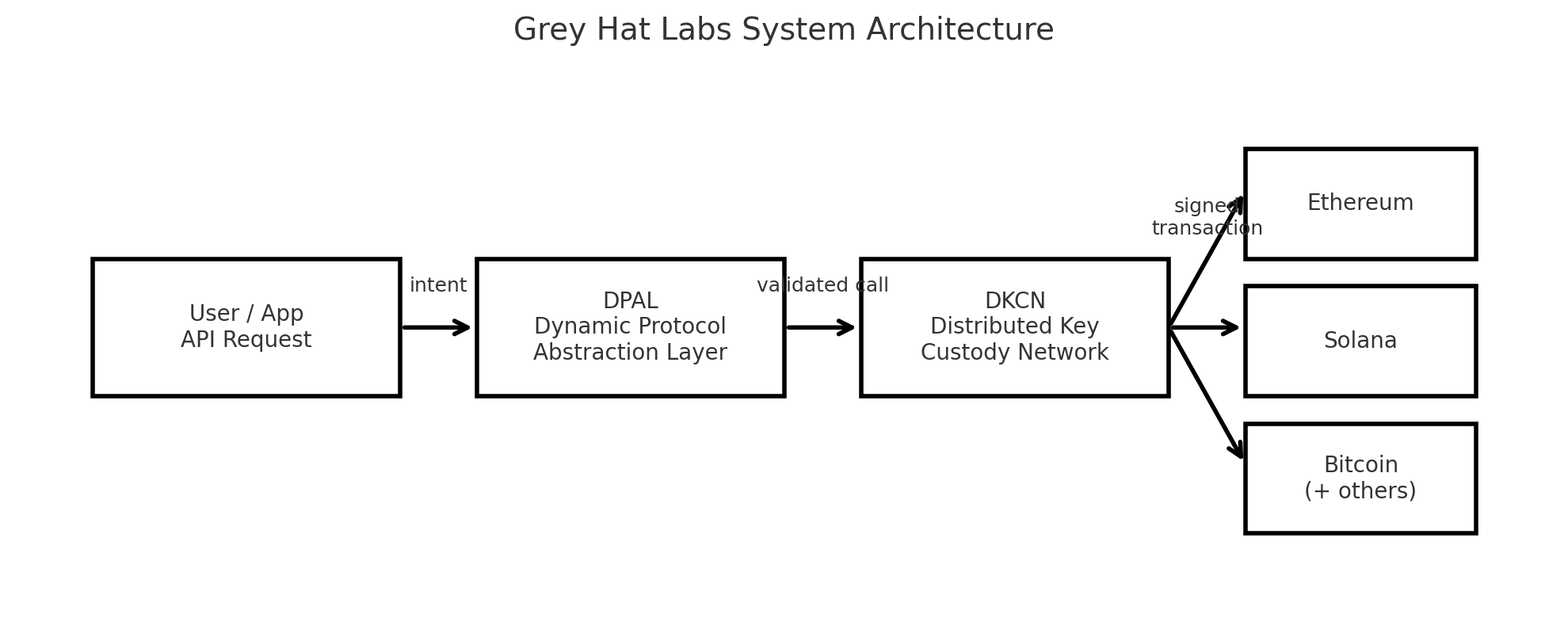
is distributed, and from the caller’s perspective the workflow is atomic and auditable.
R&D Roadmap
We are currently in R&D and prototyping, with a clear path from feasibility to pilot deployments and
production infrastructure.
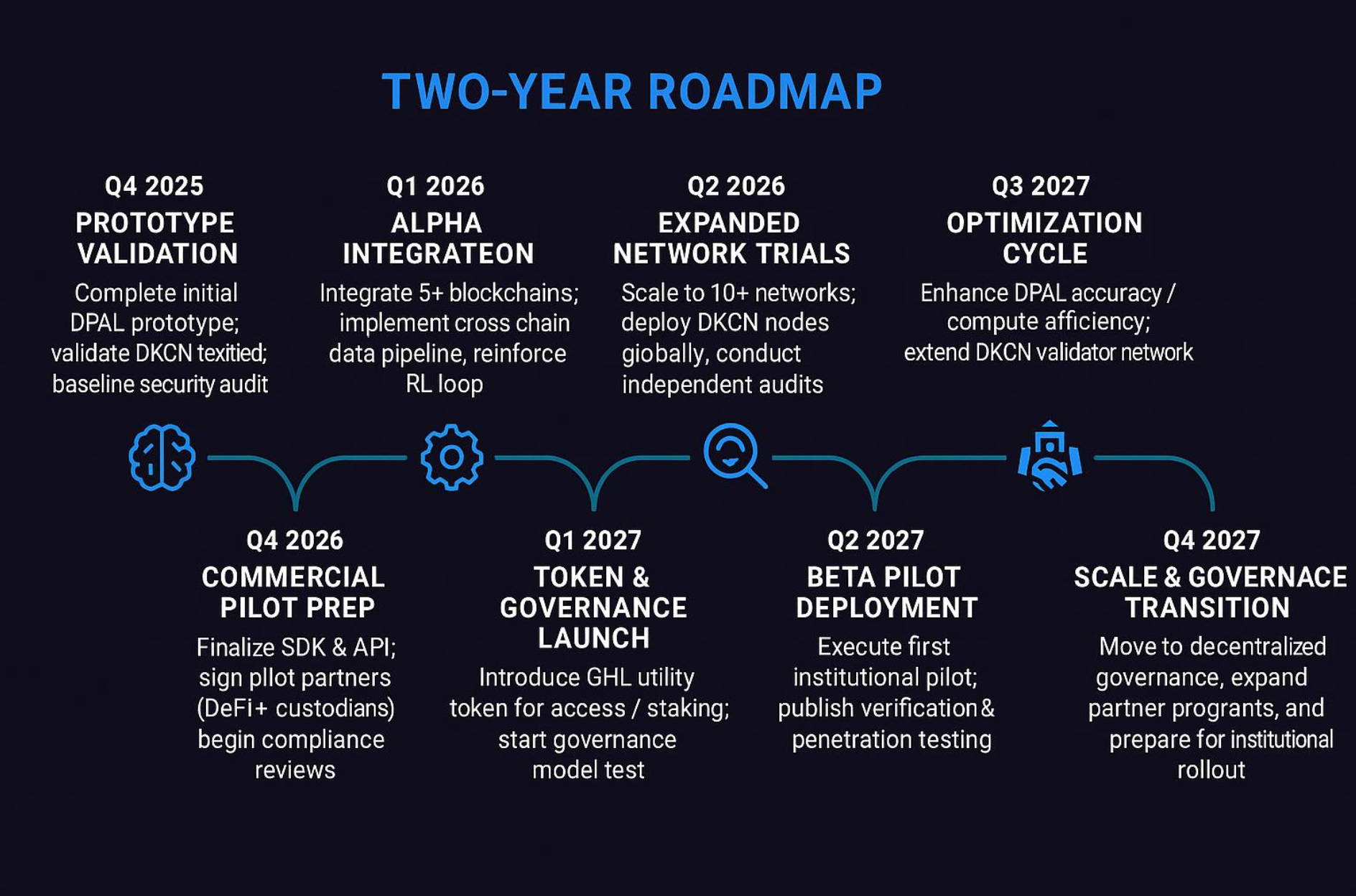
Phase I: 0–9 Months
- DPAL core model and interpreter loop.
- DKCN prototype for distributed custody.
- Live cross-chain transaction demonstration.
Phase II: 9–24 Months
- 10+ supported blockchains.
- AI-driven trade routing engine.
- Pilot partners (custody, DeFi, institutional infrastructure).
Toward Commercial Launch
- Security audits and compliance review.
- Institutional onboarding and SLAs.
- Developer SDK, API access, and integration support.