One of the hardest parts of building Grey Hat Labs hasn’t been the technology — it’s been explaining it.
Our platform spans schema normalization, graph ingestion, policy evaluation, and adaptive risk — all working together across multiple domains. It’s powerful, but that power can be hard to see without context.
This week, we shipped something important: a fully gated Partner / Institution Demo that makes the system understandable in minutes — without mocks, slides, or hand-waving.
Why we built it
We already had a working MVP and a gated demo. But we kept running into the same problem:
“I get that it’s sophisticated… but what does it actually do for me?”
The answer depends on who you are:
• A custodian thinks in terms of asset flows and custody risk
• An asset manager thinks in portfolio actions and compliance
• A fintech platform thinks in user flows, logins, messages, and documents
So we stopped trying to explain the platform abstractly — and instead let people experience it from their own perspective.
What the Partner Demo does
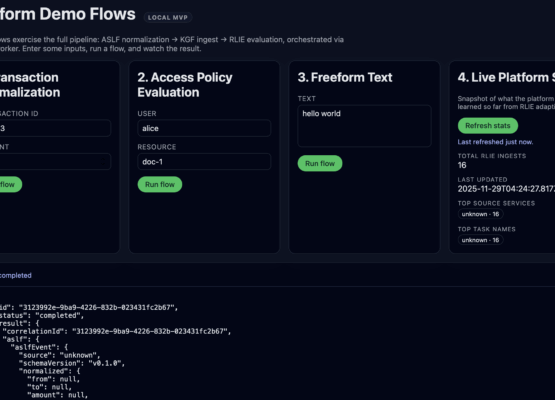
The Partner Demo is a real, end-to-end slice of the Grey Hat Labs platform:
• Requests are authenticated behind the existing demo session
• Scenarios are executed against live services, not mocks
• The same ASLF → KGF → RLIE pipeline used in production is exercised
• Results are rendered in a way that’s understandable to non-engineers
From the UI, users can select:
• A persona (Custodian, Asset Manager, Fintech Platform)
• A scenario type (asset movement, login event, document event, message event)
• Scenario parameters (networks, assets, custody mode, etc.)
Behind the scenes, each scenario produces:
• A realistic ASLF payload (not just a “kind” flag)
• A scenario-aware subject identity
• A live RLIE policy evaluation with a score and decision
• A human-readable risk narrative explaining what kind of risk is being assessed
The important part: nothing is fake
This isn’t a UI prototype.
• ASLF normalizes real payloads
• KGF ingests real graph events
• RLIE runs real policy evaluation
• Scores, labels, and IDs come from the actual system
Some downstream systems (like custody orchestration) are still simulated — and we call that out clearly — but the core intelligence layer is real.
That was a deliberate choice. Demos should build trust, not illusions.
Risk, explained like a human
One of the most valuable changes we made was adding a risk narrative.
Instead of just saying “High risk” or “Low risk,” the demo now explains why:
“From the Custodian perspective, this scenario is assessed as high cross-chain flow & routing risk.”
The same score can mean very different things depending on context — and the platform is designed to reflect that. This demo finally makes that visible.
Why this matters
This Partner Demo does a few key things for us:
• Investors can understand the platform without a 30-minute walkthrough
• Partners can immediately see where they would integrate
• Engineers can verify that the system is real, composable, and extensible
Most importantly, it turns complexity into something you can interact with, not just read about.
What’s next
This is not the end state — it’s a foundation.
Next steps include:
• Richer scenario payloads and policy dimensions
• Deeper integrations with custody and execution systems
• Guided demo flows for live presentations
• Expanded observability into how decisions are formed
But for now, we’re excited to finally have a demo that reflects what Grey Hat Labs actually is:
a real system solving real problems, end to end.
—
If you’d like to see the Partner Demo in action or explore an integration, get in touch.
– The Grey Hat Labs team